The 38-hour sprint doesn't happen because you decided to be disciplined. It happens because something — the problem, the deadline, the stakes — crossed a neurochemical threshold that turned the executive function system on at full capacity. The question is not how to summon the will to work. The question is how to cross the threshold deliberately rather than waiting for circumstances to cross it for you.
This is the difference between treating ADHD as a liability to be managed and treating it as an engine to be operated. The engine is real. It is more powerful than most neurotypical work modes. It just requires specific ignition conditions.
The PINCH Ignition System
What Reid Sterling's Sorry, You're Not Broken calls the PINCH Ignition System is a taxonomy of the five conditions that reliably trigger Hunter-mode engagement. Understanding the taxonomy lets you engineer the conditions rather than waiting for them.
P — Pressure. Not stress. Manufactured urgency. The distinction: stress is diffuse, paralyzing, unresolvable. Urgency is specific, clarifying, immediately actionable. Create a hard public commitment with a real deadline — a client call where you present the work, a public announcement with a specific date, a financial consequence that activates at non-completion. The deadline must be real. An ADHD brain processes fake deadlines as fake.
I — Interest. The Interest-Based Nervous System (Dr. William Dodson) requires genuine engagement, not performed enthusiasm. You cannot fake yourself into interest. But you can find the interesting angle within an uninteresting task: What's the most counterintuitive approach? What would happen if the opposite were true? What's the constraint that makes this problem genuinely difficult? Reframe the task until you find the version that fires.
N — Novelty. ADHD brains have higher novelty thresholds — they require more new input to maintain engagement. Novelty injection means deliberately introducing new variables into stale work: different environment, different time of day, different format, different constraint, different collaborator. The content of the work doesn't have to change — the context does.
C — Challenge. The engagement sweet spot is above routine (which produces boredom) and below overwhelm (which produces shutdown). Challenge calibration means adjusting the difficulty threshold so the problem is genuinely demanding without being catastrophically complex. Artificial challenge works: time constraints, reduced resources, tighter requirements, competitive framing.
H — High Stakes. Real consequences activate the urgency response that routine importance cannot. Stakes manufacturing means creating genuine skin in the game: public commitments, financial exposure, reputational consequences, competitive situations where performance is visible. The stakes must be proportional to the required engagement level — a $20 bet doesn't fire a 14-hour sprint; a public launch commitment does.
The PINCH system is not a productivity hack. It is a neurochemical operating protocol. The Hunter brain does not respond to importance — it responds to PINCH conditions. Build the conditions first. The work follows from the chemistry, not from the intention.
The Cognitive Fortress Morning Protocol
The ADHD brain's most powerful work window is typically the first two to four hours after waking — before the executive function system is loaded with reactive tasks, before the notification environment has injected its priorities into available working memory. The Cognitive Fortress Morning Protocol is a set of practices for protecting that window.
- Zero notifications for the first two hours. No phone check, no email open, no social media. The first notification is a priority injection from someone else's agenda. One notification before you've started your own work can derail the entire window.
- Analog planning before digital engagement. Physical notebook, specific single task, written success criterion. The physical act of committing to a specific outcome pre-loads the target before the digital environment can compete for the executive function resources.
- Environment pre-configuration. The workspace is configured before sleep the night before. Tools ready, distractions removed, session parameters set. Decision fatigue in the morning is a window-killer.
- Single-task commitment. Not a to-do list. One thing. The most valuable thing. Written as an outcome, not an activity: not "work on proposal" but "complete sections 2 and 3 of client proposal with specific recommendations."
AI as the Hunter's Operational Infrastructure
The AI economy offers Hunter brains something that has never existed before: an Operational Farmer on demand. The routine tasks that drain Hunter neurochemical resources without generating proportional value — email management, document formatting, scheduling, research compilation, report generation — can now be delegated to AI systems.
This is not about replacing thinking. It is about preserving the neurochemical conditions required for Hunter-mode thinking by eliminating the routine task load that depletes them. The Hunter's value is in the 38-hour sprint, the pattern recognition, the first-mover commitment. That value is maximized when the Hunter is not also managing the operational infrastructure that an AI system can run for $200 a month.
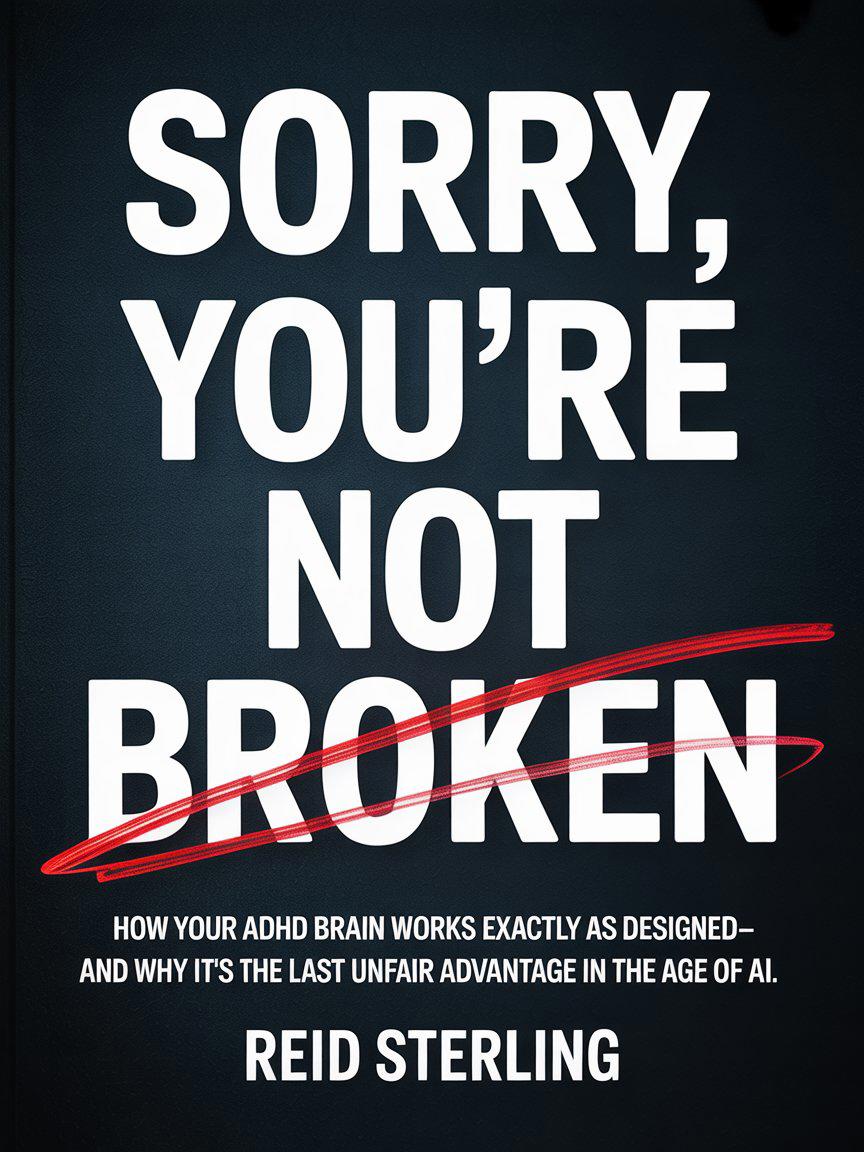
Reid Sterling's framework for engineering the five environmental conditions that trigger ADHD hyperfocus: Pressure (manufactured urgency), Interest (genuine engagement), Novelty (new variables), Challenge (calibrated difficulty), and High Stakes (real consequences). The system acknowledges that ADHD brains run on interest-based neurochemistry and provides practical tools for creating the conditions that generate dopamine without waiting for natural inspiration.
Through the PINCH system: novelty injection (new variables in stale work), deadline architecture (real public commitments with consequences), stakes manufacturing (genuine risk in artificially safe situations), challenge calibration (difficulty adjusted to cross the engagement threshold), and for some brains, controlled chaos — new locations, time constraints, public settings that fire the urgency response. You cannot will yourself into hyperfocus, but you can engineer the conditions that produce it.
Sterling's structured protocol for protecting the ADHD brain's peak cognitive window: zero notifications for the first two hours, analog planning before digital engagement, pre-configured environment, and single-task commitment written as an outcome. The goal is protecting the neurochemical conditions that allow Hunter-mode work to fire before reactive tasks deplete them.
No. Hyperfocus is directional — it fires with the same intensity on the wrong problem as the right one. The tactical work is pre-committing to the correct target before triggering it. Sterling's pre-session framing protocol involves identifying the single most valuable problem, writing the desired outcome explicitly, and establishing the success criterion before engaging the ignition system.
The Two-in-a-Box pairs a Hunter with a Farmer who handles the routine tasks that drain Hunter neurochemical resources without generating proportional value. This allows the Hunter to operate exclusively in high-leverage, high-interest work — preserving the neurochemical conditions required for productive hyperfocus rather than burning them on administrative maintenance.