The best 48 hours of my professional life ended with the power going out. I had launched a full market entry — not a prototype, not a beta, a live, aggressive market launch — in 38 hours without sleep, without a team, running on pure neural fuel. Then Thursday afternoon: no power. I owed $40 on a utility bill. I had the money. I never had the dopamine required to make paying a routine bill feel like anything other than moving a mountain underwater.
I sat in the dark, genuinely laughing. Because what else do you do when the same brain that just ran a 38-hour operational sprint cannot consistently process an automatic payment? What else do you do when you are, simultaneously, the most and least functional person in every room you enter?
The answer — the actual scientific answer, not the motivational-poster version — is that you are not broken. You are running the correct software in the wrong operating environment. And for the first time in ten thousand years, that is about to change.
Section 1: The Hunter/Farmer Framework
Ten thousand years ago, before the Neolithic Revolution made sedentary farming the dominant human lifestyle, the traits now classified as ADHD were not deficits. Continuous peripheral scanning wasn't distractibility — it was survival architecture. Impulsivity wasn't a failure of executive function — it was the decision speed that separated the predator from the prey. Novelty-seeking wasn't a disorder — it was what drove the exploration that found new food sources, new territories, new solutions to immediate, life-threatening problems.
The Hunter/Farmer framework — developed by Thom Hartmann in the 1990s and expanded significantly in the scientific literature since — proposes a simple thesis: ADHD traits evolved as adaptations for nomadic hunter-gatherer environments, and the Neolithic Revolution stranded a significant minority of the population in a sedentary world their neurology was never designed for.
The corporate office is a farm with better lighting and Slack. Open offices, annual performance reviews, nine-to-five schedules, weekly status updates, quarterly planning cycles, and mandatory onboarding videos — every one of these is a Farmer's operating system, and every one of them is catastrophically incompatible with a Hunter's neurology.
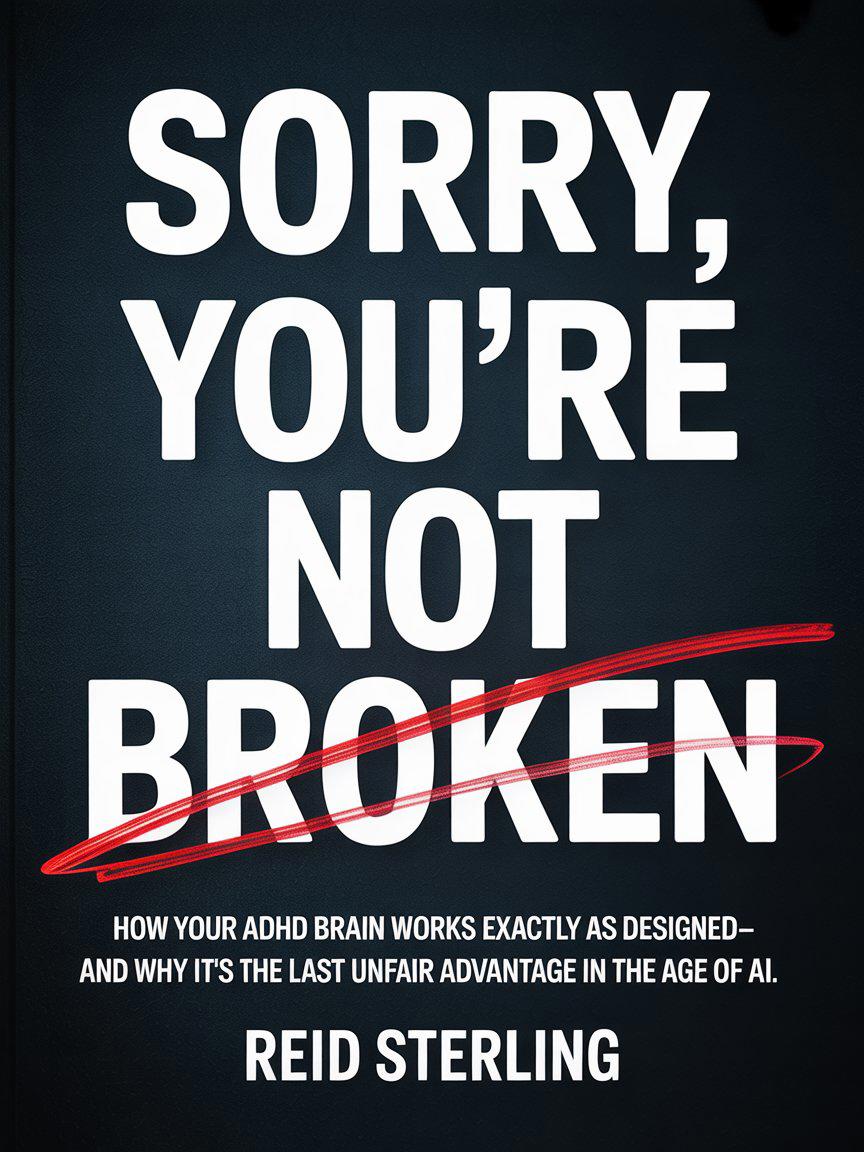
What Reid Sterling's Sorry, You're Not Broken calls the Hunter/Farmer mismatch is not a personality problem. It is an environmental incompatibility that has been misclassified as a neurological defect for fifty years of psychiatric history.
Section 2: The DRD4 7R Nomad Gene — The Study That Changes Everything
In 2008, anthropologist Dan Eisenberg published a study that should have rewritten the clinical conversation about ADHD. It didn't — because the clinical establishment had financial and institutional reasons to prefer the deficit framing. But the data is what it is.
Eisenberg studied two groups of the Ariaal people of northern Kenya: one group that maintained traditional nomadic pastoralism, moving with their herds across the savanna; another group that had settled in permanent villages. Both groups were genetically similar. Both groups included carriers and non-carriers of the DRD4 7R allele — the genetic variant most strongly associated with ADHD traits.
In the nomadic group: carriers of the 7R allele were measurably better nourished, had higher body mass index, showed greater leadership status within their communities, and were evaluated by community members as more capable and effective.
In the settled group: carriers of the same 7R allele showed lower BMI, poorer nutritional status, and lower community standing.
Same gene. Same person, essentially. Two environments. Two completely opposite outcomes. The nomadic environment amplified the 7R allele's traits into survival advantages. The sedentary environment converted those same traits into deficits.
They named it a Deficit. They called it a Disorder. They handed you a label that begins with a minus sign, and then charged you for the privilege of carrying it — and the entire basis for the clinical framing is an environment mismatch, not a neurological defect.
The DRD4 7R allele is not a broken gene. It is a gene that is optimized for a specific category of environment. The Ariaal nomadic carriers were not healthier because they worked harder or were more disciplined. They were healthier because their environment finally matched their neurology. The settled carriers were not failing because they were less intelligent or less capable. They were failing because they were running the wrong hardware in the wrong operating context.
Section 3: The Interest-Based Nervous System
Dr. William Dodson's research on ADHD neurology provides the most precise clinical explanation for the phenomenon that every ADHD person knows intimately but cannot explain to their manager: how the same person can work with flawless focus for fourteen hours on a project they're excited about and cannot, with genuine effort, produce forty-five minutes of sustained attention on a task that is objectively important.
Neurotypical — Farmer — brains run on an importance-based system. When a task is flagged as important, either by the person or by authority, the brain generates dopamine proportional to that importance. The dopamine provides the motivational fuel for action. Obligation works. Deadlines work. "This matters" works.
ADHD — Hunter — brains run on an interest-based system. Importance alone does not generate the neurochemical fuel required for action. What generates that fuel: interest, novelty, urgency, challenge, competition, or passion. This is not a metaphor. This is chemistry — specifically, the regulation of dopamine transmission through the D4 receptor pathway that the 7R allele affects.
The practical implication is radical: the 14-hour architectural sprint on a new product and the 4-day unanswered email about a mailing address update are produced by the same brain for the same neurochemical reason. The sprint fires because the interest is there. The email doesn't fire because importance, in the absence of interest, does not produce dopamine. The brain is not broken. The task is wrong for the brain.
Section 4: Why the AI Economy Is the First Environment Built for Hunters
Here is what has changed. The AI economy has decoupled execution from value creation. For the first time in the history of knowledge work, the routine tasks — the administrative processing, the report generation, the email triage, the scheduling, the documentation, the data formatting — can be delegated to a machine. What remains is the work that requires judgment, pattern recognition, novelty navigation, and the explosive burst of focused energy that Hunter brains produce under the right conditions.
- Hyperfocus: The 38-hour market launch is not a liability — it is the product. When AI handles the routine infrastructure, the Hunter's most extreme capability becomes the entire value proposition.
- Pattern recognition: Seeing market gaps that sequential thinkers miss, connecting disparate signals into coherent insights — this is the Hunter cognitive architecture operating in its native mode.
- Novelty-seeking as first-mover advantage: The trait that made Farmers call you scattered is what makes you commit before the committee forms. In markets where speed is leverage, this is not a character flaw.
- Impulsivity as execution speed: The bias toward action that gets Hunter brains classified as impulsive is the same trait that makes them move while neurotypical competitors are still in discovery workshops.
The AI economy doesn't reward people who can reliably process routine tasks at scale. AI does that. The AI economy rewards people who can identify which routine tasks matter, why they matter, and what to do with the results. That is a Hunter operating at maximum capacity in the environment it was built for.
Section 5: The Two-in-a-Box Framework and the PINCH Ignition System
Every Hunter needs a Farmer. This is not a hierarchical statement — it is an operational observation. The Hunter provides vision, hyperfocused execution bursts, pattern recognition, and the willingness to move before the risk calculus is complete. The Farmer provides operational continuity, administrative follow-through, system maintenance, and the reliable processing of the routine tasks that Hunter brains will not sustain.
The Two-in-a-Box framework in Sorry, You're Not Broken is not about finding someone to manage you or compensate for your deficits. It is about assembling a cognitive architecture that covers the full spectrum of operational requirements. A Hunter-only operation runs extraordinarily hot and burns the infrastructure. A Farmer-only operation runs stable and never catches fire. The Two-in-a-Box is a partnership of different cognitive architectures producing outcomes neither could produce alone.
The Tuesday Folder is the operational containment system: all routine administrative tasks — the bills, the contracts, the scheduling requests, the paperwork — batched into a single weekly processing block. Not because the Hunter suddenly gains the dopamine required to enjoy administrative work. But because containing it to a defined time and context with a clear deadline creates the urgency trigger that the interest-based nervous system requires.
The PINCH Ignition System is the tactical framework for engineering the environmental conditions that fire Hunter-mode hyperfocus. Not waiting for inspiration. Constructing it. Novelty injection: introducing new variables into a stale problem. Stakes manufacturing: creating real consequences with real timelines. Constraint design: narrowing the problem space until the urgency threshold is crossed. Chaos as fuel: some Hunter brains perform best in the minutes before the catastrophe, and that is a deployable capability, not a character flaw.
The evidence is specific and structural, not motivational. Dan Eisenberg's 2008 study of the Ariaal tribe found that the DRD4 7R allele — the genetic variant most strongly associated with ADHD traits — produced measurably better health outcomes in nomadic contexts and measurably worse outcomes in settled contexts. Same gene. Opposite results depending on environment.
Sterling's argument in Sorry, You're Not Broken is not that ADHD is an advantage in every environment — it is that the AI economy is finally the right environment for ADHD cognitive architecture. That's a precise claim, not a motivational poster.
Developed by Thom Hartmann and expanded by Reid Sterling, the Hunter/Farmer framework proposes that ADHD traits evolved as adaptations for nomadic hunter-gatherer environments. When agriculture replaced nomadic life 10,000 years ago, those traits became liabilities in sedentary, routine-dependent environments.
The corporate office is a farm. ADHD entrepreneurs are Hunters running a Farmer's operating system. The mismatch is environmental, not neurological.
The DRD4 7R allele is a genetic variant of the dopamine receptor D4 gene strongly associated with ADHD traits: novelty-seeking, impulsivity, risk tolerance, and reduced response to routine stimuli. Dan Eisenberg's 2008 Ariaal tribe study found that nomadic carriers of 7R were measurably healthier than settled carriers with identical genetics.
Sterling calls this the Nomad Gene — optimized for the environment it evolved for, systematically disadvantaged by sedentary environments it wasn't designed for.
Dr. William Dodson's research identifies the Interest-Based Nervous System as the mechanism. Neurotypical brains run on importance: when something is flagged as important, dopamine fires. ADHD brains run on interest: importance alone doesn't generate the neurochemical fuel required for action. What does: interest, novelty, urgency, challenge, or passion.
This is not a metaphor — it's the D4 receptor pathway. The 14-hour sprint on a new project and the 4-day unanswered email about a mailing address are the same brain operating on the same chemistry. The sprint fires. The email doesn't. Neither is a character flaw.
Sterling's Two-in-a-Box framework pairs a Hunter (visionary, hyperfocused, chaos-tolerant) with a Farmer (operational, systematic, routine-capable). The Tuesday Folder batches administrative tasks into a single weekly block to create urgency triggers. The PINCH Ignition System engineers the environmental conditions that fire hyperfocus on demand.
The AI economy makes the Solo Operator model increasingly viable for Hunters — AI handles the Farmer tasks (routine execution), freeing the Hunter to operate exclusively in the high-leverage creative and strategic mode where their neurology is most effective.