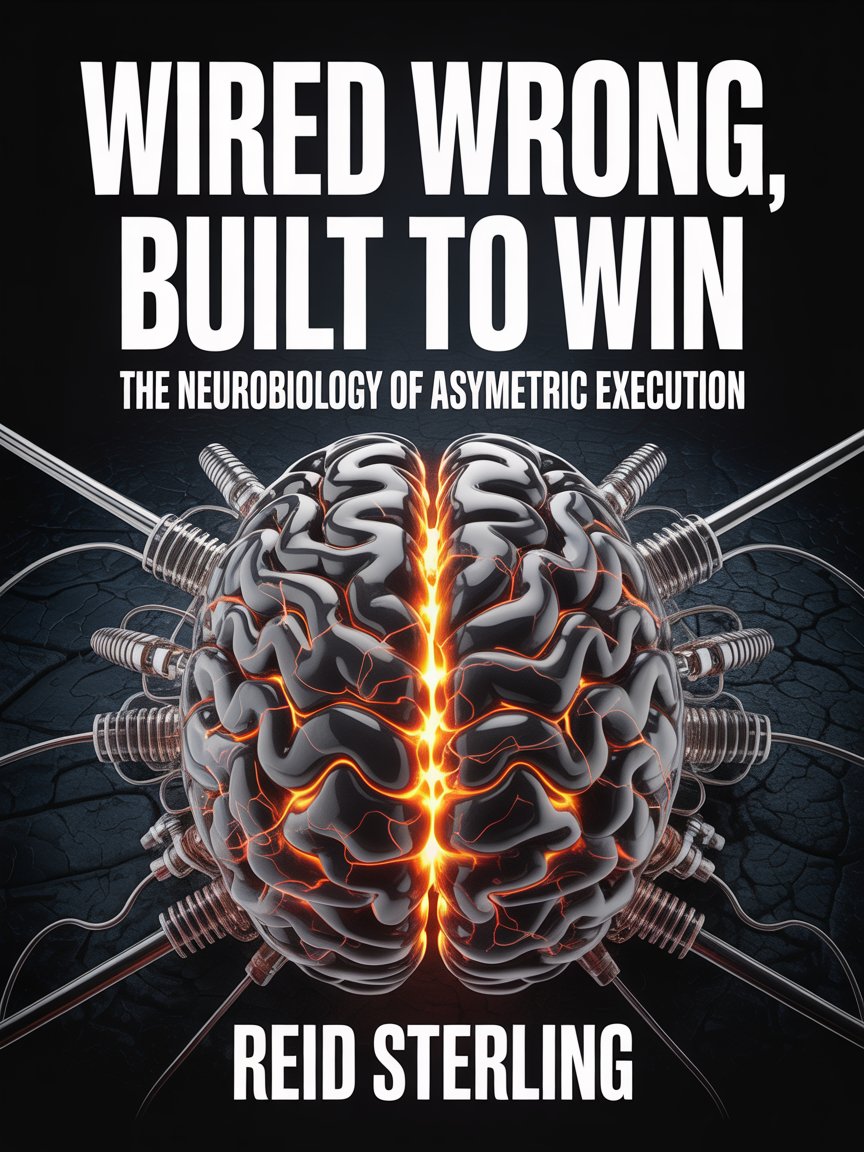
Book 02 of 4 — The Operating Manual
Wired Wrong, Built to Win — by Reid Sterling
Get the Specification
Author's Warning

Wired Wrong, Built to Win. The Operating Manual for the Hunter Architecture.

"This book is not a self-help guide. It is a technical specification for weaponizing your architecture."

— Reid Sterling

Your brain isn't broken. It's a 40,000-year-old Hunter architecture misdeployed in a Farmer ecosystem. Every corporate system, productivity framework, and calendar app was built for Farmers — people optimized for routine, repetition, and incremental process.

You are not a broken Farmer. You are a misdeployed Hunter. This book is the OS shift: from importance-based tasks to intensity-based ignition. Stop apologizing for how your brain runs. Start running it correctly.

The Unfair Advantage Playbook: Book 01 ▶ Book 02 Book 03 Book 04

The Core Thesis

"Stop trying to be a better Farmer. Start being a lethal Hunter. The OS shift isn't a productivity hack. It's a species-level redeployment."

— Wired Wrong, Built to Win

Proprietary Frameworks

The Hunter Operating System

Four proprietary frameworks that rewire how you deploy your architecture. Not metaphors. Not motivational frameworks. Operational specifications.

Framework 01
Time Collapse

The state where 30 days of standard output compresses into 72 hours of hyper-focused execution. This is not an accident of motivation or caffeine. It is the predictable result of deploying all five PINCH triggers simultaneously against a high-stakes target. Time Collapse is engineerable. This book shows you how.

Framework 02
PINCH Ignition System

The Hunter brain responds to exactly five ignition triggers: Passion, Interest, Need, Competition, and Hurry. Without them, the engine idles. With all five firing, the Time Collapse state becomes accessible on demand. PINCH is not a motivational framework. It is a neurological ignition sequence. Learn to engineer it deliberately.

Framework 03
The Crash Receipt

The mandatory neurochemical bill that follows a sprint. After a Time Collapse event, the Hunter brain presents a Crash Receipt — a period of apparent dysfunction that is actually neurological rebalancing. This is not weakness. It is arithmetic. Understanding the Crash Receipt allows you to plan for it, protect against it, and use it as signal rather than shame.

Framework 04
The Leaky Filter

The Hunter brain's inability to filter background noise — the classic ADHD "distraction" — is actually a superpower for cross-domain pattern recognition. Farmers filter efficiently. Hunters process everything. In a Farmer environment, this is dysfunction. In a high-complexity, rapidly-changing environment, this is the unfair competitive advantage. The Leaky Filter explains why ADHD operators consistently see solutions that specialists miss.

Framework 05
The OS Shift

Moving from importance-based task selection (the Farmer OS: do what matters most) to intensity-based ignition (the Hunter OS: do what the brain responds to). This is not abandoning discipline. It is operating the correct software for your hardware. The OS Shift is the single most high-leverage reframe in the book — everything else is downstream of it.

Framework 06
Retiring the Apology

Moving from "I'm sorry I'm inconsistent" to "Here are my operational specifications." The apology is the cognitive cost of running Hunter hardware in a Farmer world. Retiring it doesn't require changing your environment. It requires understanding your architecture well enough to specify it — and finding the collaborators, clients, and contexts where that specification is a feature, not a defect.

The Architecture Gap

Hunter vs. Farmer

The corporate world was built for one of these. You are the other. That is not a problem to fix. It is a deployment error to correct.

Hunter Architecture (You)
  • Ignites on intensity — pressure, novelty, high stakes, competition
  • Time Collapse: 30 days of output in 72 hours under full PINCH ignition
  • Leaky Filter: processes everything, enabling cross-domain pattern recognition
  • Optimal environment: chaos, ambiguity, rapid context-switching, high stakes
  • Pays a Crash Receipt after sprints — neurochemical rebalancing, not weakness
  • Built for environments where the rules keep changing and speed matters
  • DRD4 7R "Nomad Gene" — linked to novelty-seeking and exploratory behavior
Farmer Architecture (The System)
  • Runs on importance — prioritize by rational rank order, execute sequentially
  • Consistent daily output — predictable, sustainable, incrementally compounding
  • Efficient filter: blocks irrelevant inputs, maintains focus on the task queue
  • Optimal environment: routine, structure, clear process, predictable timelines
  • Recovers fully between days — no deficit carried forward from productive periods
  • Built for environments with stable rules and incremental improvement cycles
  • The architecture the entire corporate operating system was designed to serve

From the Book's Appendix

Hunter Deployment Checklist

The ten-point operational checklist from the book's appendix. Not goals. Not affirmations. Operational specifications for redeploying the Hunter architecture correctly.

01
Audit your ignition triggers

Map your last five periods of peak output. Identify which PINCH triggers (Passion, Interest, Need, Competition, Hurry) were present in each. This is your ignition profile — use it to engineer future sprints.

02
Identify your Crash Receipt pattern

After each major sprint, document the duration and depth of your Crash Receipt. You are not depressed. You are paying the neurochemical bill. Knowing your pattern lets you schedule around it rather than being ambushed by it.

03
Run the OS Shift on your task list

Sort your current obligations not by importance but by ignition likelihood. Which tasks have multiple PINCH triggers attached? Prioritize those. Let AI handle the low-intensity execution work while your Hunter engine runs hot on the high-ignition work.

04
Build your Time Collapse container

Identify one project where you can engineer all five PINCH triggers simultaneously. Set a 72-hour window. Remove every Farmer-environment obligation from that window. Run the experiment. The Time Collapse state is real. You need to experience it deliberately at least once to trust it.

05
Map your Leaky Filter patterns

List the last three times a "distraction" led to an insight, connection, or solution that a more focused person would have missed. Document the pattern. The Leaky Filter is not random — it has a profile. Understanding it lets you channel it rather than suppress it.

06
Write your Operational Specifications

Draft a one-page document titled "How I Run." Include: your ignition triggers, your crash receipt timeline, your optimal working environment, your peak hours, and the conditions under which your output becomes extraordinary. This replaces the apology in every professional relationship.

07
Identify your Two-in-a-Box partner

The Hunter architecture at full deployment generates output that requires a Farmer partner to operationalize. Identify one person in your life or network who is a strong Farmer — detail-oriented, routine-seeking, process-driven. Explore what a structured collaboration looks like.

08
Eliminate the apology infrastructure

Identify every professional obligation, relationship, or commitment that exists primarily because you apologized for your architecture and agreed to operate on someone else's schedule. Renegotiate the terms or exit the obligation. You do not owe anyone a Farmer performance from a Hunter brain.

09
Deploy AI as a Farmer proxy

AI is the best Farmer proxy ever built. It handles the routine, incremental, consistency-dependent execution work that the Hunter brain burns energy resisting. Configure your AI stack to handle the Farmer tasks — scheduling, documentation, follow-up, formatting, sequencing — so your Hunter engine handles only the work that requires ignition.

10
Commit to the 30-day specification trial

For 30 days, operate according to the Operational Specifications you wrote in Step 6. Communicate your architecture explicitly rather than apologetically. Measure the output difference. At the end of 30 days, you will have enough data to decide whether the apology was ever worth what it cost you.

The Unfair Advantage Playbook

Four Books. One System.

The Diagnosis → The Operating Manual → The Blueprint → The Takedown. Read in order, or enter at the crisis point. Either way, you're not leaving the same operator you were.

Book 01
Sorry, You're Not Broken

The Diagnosis. How your ADHD brain works exactly as designed.

Get on Amazon →
Book 02 — You Are Here
Wired Wrong, Built to Win

The Operating Manual. The technical specification for weaponizing your architecture.

Get the Specification →
Book 03
The Skill Bankruptcy

The Blueprint. Weaponize the machine that killed your expertise.

Get on Amazon →
Book 04
Obsolete By Noon

The Takedown. Fire your consultants. Bypass the suits.

Get on Amazon →

The Tuesday Folder

Get the next one before it's a chapter.

Weekly operational tactics, AI frameworks, and Hunter-specific field dispatches. Every Tuesday. No sponsors. No watered-down takes. Just the actual playbook.