You're in a boardroom. The consultant has a 94-slide deck. Slide 11 has a four-quadrant matrix with axes labeled "Operational Velocity" and "Transformational Readiness." You're nodding. You have been nodding for forty minutes. You do not understand any of this. You are paying $450 an hour.
And here is the brutal truth: that confusion is the product. The incomprehension is the deliverable. The fog is not a failure of communication — it is the most precisely engineered feature in a system that has been running this exact play for seven centuries.
Section 1: The Complexity Scam, Defined
The Expert Class doesn't sell solutions. They sell friction. The consulting industry's core business model requires that the client remain permanently confused, permanently dependent, and permanently afraid to ask if this is actually working.
What Reid Sterling calls "The Fog Machine" is the deliberate manufacture of complexity as a profit center — not the accidental byproduct of technically demanding work.
MIT researchers did something elegant in their study of legal contract language. They analyzed ten million words of real legal documents and asked a straightforward question: is legal language complex because the underlying ideas are complex, or is it complex because the people writing it chose to make it that way?
The answer came back unambiguous: legal complexity is a stylistic choice. The ideas themselves are not inherently difficult. They are expressed through a specific technique called center-embedding — the insertion of conditional clauses into the middle of sentences — that systematically detonates working memory and prevents comprehension. When the researchers asked non-lawyers to draft legal documents, those non-lawyers instinctively adopted the same convoluted structure. Not because it was required. Because incomprehensibility is the aesthetic of power.
Your 47-page employment agreement is not 47 pages because the terms are complicated. It is 47 pages because the person who wrote it needed you to believe that you require them to understand it.
Section 2: Seven Hundred Years of the Same Racket
The medieval craft guild is the original template. Cap apprentices. Control pricing. Make entry expensive. Make competition illegal. The guild did not sell expertise — it sold access to expertise by eliminating all alternative routes to that expertise.
The medical guild gave us "nostrum remedium" — Latin prescriptions that patients couldn't read. Not because medicine required Latin. Because a patient who can read their own prescription is a patient who can ask questions, seek second opinions, and potentially procure the treatment without a physician's involvement. Latin was a firewall, not a precision instrument.
English courts operated in Law French after the Norman Conquest — a language ordinary citizens couldn't follow — until Parliament mandated the use of English in 1362. The legal profession complied in speech. They kept Latin in written documents. The firewall simply migrated from one medium to another.
McKinsey's 94-slide deck is Law French. Your 47-page employment agreement is nostrum remedium. The delivery mechanism has changed. The structural purpose — keeping you dependent and confused — has not moved an inch in seven hundred years.
This is not a conspiracy theory. It is guild theory — documented, systematic, and sitting in academic literature that the people operating the guild would prefer you not read.
Section 3: The Billable Hour Is a Structural Conflict of Interest
Here is the mathematics of consulting economics. If you solve a problem in three weeks, you bill three weeks. If you solve it in eight months — with discovery phases, steering committees, stakeholder alignment sessions, and a second phase of "deep implementation" — you bill eight months.
The billable hour does not reward problem-solving. It rewards problem duration. This is not a bug that crept into the system through negligence. This is the system's most fundamental design feature. A consultant who solves your problem in three weeks is a consultant who just destroyed 75% of their potential revenue on your engagement.
BCG's own research documents €20 billion wasted annually on enterprise programs that fail to deliver. This is not BCG exposing someone else's failure. This is BCG's data about BCG's market. And they published it. Because the existence of failure is not a threat to their business model — it is their business model. Failure creates the next engagement.
A survey of executives who hired Big Three consulting firms for major transformations found that 84% said consultants were "no help at all." This figure comes from a survey of the consulting industry's own clients. The consultants know this number. They keep operating. The math still works.
Section 4: It's Not Your Money They're After. It's Your Confidence.
The deeper game is not extracting your budget. It is extracting your belief in your own competence. A client who doubts themselves is a client for life. A client who says "I don't understand what you're recommending, but you clearly do" has just signed an indefinite retainer.
David Graeber's concept of "Managerial Feudalism" is useful here. In his research on what he called "bullshit jobs," Graeber found that 37% of British employees believed their jobs made zero meaningful contribution to the world — at work, at their desks, actively convinced that their role was theater. The consulting industry does not create this condition. It depends on it. An organization full of people who suspect their own irrelevance is an organization that will pay anything for external validation that the work matters.
The Fog Machine doesn't just obscure the consultant's work from scrutiny. It obscures your work from you. If you can't understand the framework that describes your own business, you can't lead it without the person who can. That's the product.
Section 5: The Off Switch
AI didn't just change the economics of consulting. It detonated the foundational premise.
You were paying for access — to legal translation, financial modeling, market research, process documentation. Access to things that required expensive training to perform and even more expensive professionals to interpret. That access problem no longer exists.
- AI legal tools review standard contracts in minutes versus three billable days for a junior associate.
- IBM's HR automation handles 94% of employee inquiries without a human HR professional.
- Financial modeling that previously required a team of analysts runs in hours on platforms accessible to any operator with a laptop.
- 36% of all new businesses in the United States are now solo-founded — one person running an operation that would have required a department five years ago.
The Fog Machine still runs. The guild still exists. But the moat — the access monopoly, the information asymmetry, the client dependency — has been drained. What remains is the habit of consulting, not the necessity of it.
The question is no longer "how do I find an expert?" The question is "do I need one?" In most cases, for most tasks that were previously routed to consultants and law firms and HR departments: you do not. You need the AI stack, and you need the domain judgment to direct it. Those are both things you can build. The first is cheap. The second is already inside you.
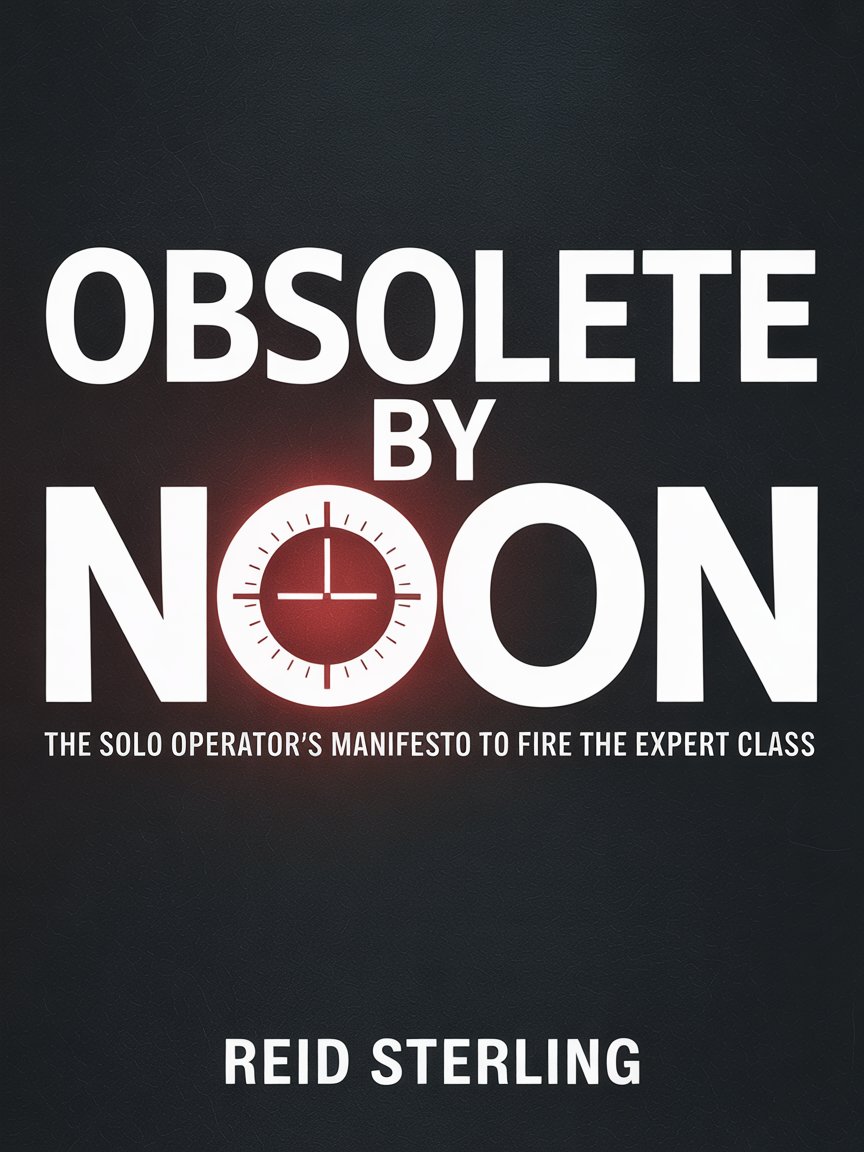
Consulting jargon is not accidental complexity — it is the product. What Reid Sterling calls "The Fog Machine" in Obsolete By Noon is the deliberate manufacture of incomprehensibility as a profit center. When clients cannot understand the work, they cannot evaluate it, challenge it, or terminate it.
MIT researchers analyzed 10 million words of legal contracts and confirmed this pattern: impenetrability is engineered through specific linguistic techniques like center-embedding, not inherent technical complexity. The same pattern operates in management consulting: the four-quadrant matrix, the "Strategic Maturation Pathway," the three-letter acronym taxonomy — all designed to signal expertise while preventing independent evaluation.
Not in the criminal sense — but 84% of executives who hired Big Three firms for major transformations said consultants were "no help at all." That's the industry's own clients. BCG's research documents €20 billion wasted annually on enterprise programs that fail to deliver.
Sterling's argument in Obsolete By Noon is more precise: consulting is a guild structure, not a scam. The guild has systematically engineered client dependency through information asymmetry — the same play that medieval craft guilds ran for 700 years. It's not illegal. It's just a business model built on manufactured helplessness.
Center-embedding is the deliberate insertion of conditional clauses into the middle of sentences, systematically overloading working memory and making comprehension near-impossible. MIT researchers studying 10 million words of legal contracts identified center-embedding as the primary mechanism of deliberate incomprehensibility.
Example: "The party of the first part, having been duly notified in accordance with Section 4(b)(ii) of this Agreement, which shall, except as otherwise specified in Appendix C, take effect upon receipt, shall be deemed…" — that's center-embedding. The information could be stated plainly in one sentence. It isn't, because plain language removes the writer's indispensability.
Two tests from Obsolete By Noon: First, can the consultant explain their recommendations in plain language to someone outside their field? If the answer requires jargon, matrices, or a follow-up engagement to interpret the previous engagement, you're paying for theater.
Second test: what decisions have actually changed because of their analysis? Not what could change — what has changed. If the work has not changed any decisions, you purchased the appearance of expertise, not the substance.
For the execution layer — data analysis, benchmarking, slide production, contract review, market research — AI has already replaced the work of junior consulting staff at a fraction of the cost. IBM's HR automation handles 94% of employee inquiries without human staff. AI legal tools review contracts in minutes versus three billable days for a junior associate.
What AI cannot replace is the domain judgment that tells it what to build and why. Sterling's Consultant Killer Stack in Obsolete By Noon identifies the specific AI tools that replace a full department for approximately $200 per month — leaving the human in the role of Architect rather than Analyst.