Everyone is waiting for the dramatic event. The mass layoff announcement. The headline: "Company Eliminates 10,000 Jobs to AI." Some of those headlines have appeared. But they are not the primary mechanism of displacement. The primary mechanism is quieter. More insidious. And almost impossible to fight.
The Data That Tells the Story
300 million. The Goldman Sachs estimate of global jobs exposed to significant automation through AI. "Exposed" means the core tasks of the role have been demonstrated as AI-replicable in controlled settings. Not all of these jobs will be eliminated. But the human premium — the additional cost of hiring a human over using AI for the same function — will either disappear or shrink to near zero.
45%. The LinkedIn decline in entry-level job postings between 2022 and 2025. Entry-level positions are the first casualties of AI displacement because they are execution-heavy and judgment-light — exactly the profile that AI handles most competently. The professionals currently in mid-career are not seeing mass layoffs. They're seeing the pipeline behind them being cut off.
11%. The Etsy workforce reduction in 2023 — the CEO explicitly cited AI as the enabling factor. This is the rare example of a company being direct about the mechanism. Most others are managing through attrition.
94%. IBM's HR automation handles 94% of routine employee inquiries without human HR staff. IBM did not announce a dramatic HR layoff. They simply stopped hiring HR staff at the rate they previously did.
19%. The US Bureau of Labor Statistics projected decline in paralegal employment — one of dozens of knowledge-worker professions with quantified negative employment outlook.
What the Silent Liquidation Actually Looks Like
You are a financial analyst at a company with 8 analysts in your department. Nobody gets fired. But over the next 24 months: one analyst leaves for a new position — the role is not backfilled, their work distributed among the remaining 7 plus AI tools the company just licensed. Eighteen months later, another leaves — again, no backfill. Six analysts doing the work of 8 with AI assistance. The company runs a "technology transformation initiative." Four analysts are asked to focus on AI tool integration and oversight rather than direct analysis production. Two analysts are let go in a "right-sizing" that follows the transformation.
Net result: from 8 analysts to 4 in 3 years. No mass layoff headline. No dramatic announcement. Just quiet, steady attrition combined with a changed job description for the survivors. The survivors are now AI supervisors, not analysts. Their role requires different skills than they were hired for. Some adapt. Some find that the skills they built their career on — the actual analysis — are no longer what's being asked of them.
What Is AIRD and How Does It Trap People?
AIRD — Artificial Intelligence Replacement Dysfunction — is the specific psychological response to professional obsolescence through AI. It has three stages that each create specific traps:
Stage 1 — Denial: "My field is different. My work requires human judgment. AI can't replicate what I do." This stage is productive for perhaps 12–18 months depending on the field. Eventually, the evidence accumulates.
Stage 2 — Bargaining: "I'll just learn to use AI tools alongside my existing work. I'll stay relevant by adopting AI." This is the most dangerous stage because it feels like action. Adding AI tools to an execution-heavy role doesn't change the underlying economics of that role — it just makes you better at a job that is still being commoditized. You are slightly more efficient at work that is becoming less valuable.
Stage 3 — Paralysis: The liquidation is now visible. The role is shrinking or gone. The identity — professional, credential, career — was tied to the expertise that is now commoditized. The size of the problem makes any single action feel futile.
The Bankruptcy-to-Blueprint Protocol is the exit from AIRD paralysis. But it only works if you start it before the liquidation reaches your specific position.
The Silent Liquidation is quiet. That quietness makes it easy to ignore until it becomes impossible to ignore. The time to start is not when you feel the urgency. The time to start is now, while you still have the luxury of doing it deliberately. The professional repositioning from a position of strength — current role, current income, current network — has far more options than the one who starts from urgent necessity.
Who Is at Highest Risk Right Now?
Immediate high risk (already underway): Paralegals and legal assistants; financial analysts and junior analysts; entry-level marketing and content roles; HR coordinators and generalists; data entry and processing roles (largely complete — this was Phase 1); research analysts; insurance underwriting (repetitive pattern evaluation).
Medium-term risk (2–4 years): Mid-level management in knowledge-work organizations (coordination functions); standard accounting and bookkeeping; radiologists and diagnostic medicine roles (image analysis); supply chain analysis and optimization roles; customer service management.
Relatively lower near-term risk: Roles requiring physical presence and human relationship (therapists, surgeons, senior client relationship managers); roles requiring novel judgment in ambiguous contexts (crisis management, senior strategy); roles in highly regulated fields where regulation specifically requires human decision-making; roles that depend on real-time, unstructured information that exists nowhere in text.
The question is not whether your specific current job will be eliminated. It is whether the skills you've built create durable leverage in an AI economy — or whether they were valuable primarily as execution skills that AI now performs more cheaply.
The Response That Actually Works
The Bankruptcy-to-Blueprint Protocol breaks the AIRD cycle and rebuilds economic position. It starts with honesty about which of your skills are AI-replicable (most execution skills) and which are not (your domain judgment, tacit knowledge, pattern recognition, and relationships).
But the protocol has a time dependency: it works significantly better when started before the liquidation reaches your position than after. The professional who begins repositioning from a position of strength — current role, current income, current network — has far more options than the one who begins from a position of urgent necessity.
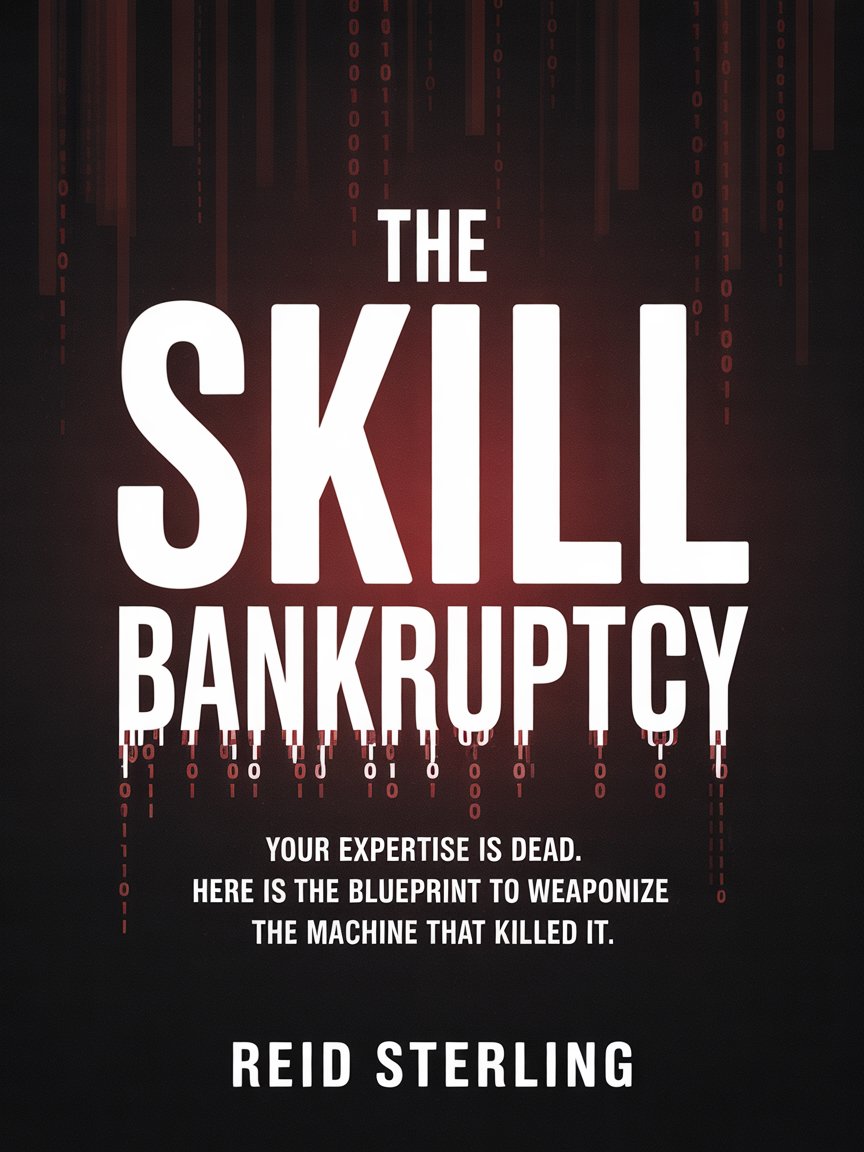
The Bankruptcy-to-Blueprint Protocol, Skill Arbitrage, Anti-Commodity Positioning, and the full One-Person Unicorn architecture are inside. The liquidation is already running. The blueprint is how you get out of its path.
Get the Survival Manual on Amazon →Frequently Asked Questions
The Silent Liquidation is Reid Sterling's term for the AI-driven hollowing of white-collar employment that is happening not through mass layoffs but through attrition — organizations simply stopping the replacement of positions when people leave, because AI now handles the functions those roles performed. Goldman Sachs identified 300 million jobs globally exposed to this process. LinkedIn data shows entry-level job postings declined 45% between 2022 and 2025. The liquidation is underway. Nobody is sending you a notice.
AIRD — Artificial Intelligence Replacement Dysfunction — is the three-stage psychological response to professional obsolescence: Denial ("my field is different"), Bargaining ("I'll just adopt AI tools"), and Paralysis (the liquidation is visible and no action feels adequate). The Bankruptcy-to-Blueprint Protocol exits the AIRD cycle — starting with an honest audit of which skills are AI-replicable and which are not, then systematically rebuilding economic position around the non-replicable layer. It works significantly better when started from a position of strength, before the liquidation reaches your specific role.
Immediate high risk: paralegals, financial analysts, entry-level marketing and content roles, HR coordinators, data entry and processing roles, research analysts, insurance underwriters. Medium-term risk (2–4 years): mid-level management coordination functions, standard accounting, diagnostic medicine, supply chain analysis, customer service management. Relatively lower near-term risk: roles requiring physical presence, human relationships, novel judgment in ambiguous contexts, or regulated fields where human decision-making is legally required.
The Bargaining stage — "I'll just learn to use AI tools alongside my existing work" — is dangerous because it feels like action. But adding AI tools to an execution-heavy role doesn't change the underlying economics of that role. It just makes you better at a job that is still being commoditized. You are slightly more efficient at work that is becoming less valuable. The stage creates the illusion of adaptation while leaving the fundamental vulnerability unchanged.
Traditional layoffs are visible, contestable, and create legal exposure. The Silent Liquidation works through attrition — not replacing roles when people leave, combined with changing job descriptions for survivors from doers to AI supervisors. This creates no layoff event, no severance dispute, no legal exposure, and no news cycle. It is more insidious because there is no specific decision to contest. By the time the liquidation is visible in your department, the structural change is largely complete.