The management consulting industry billed $250+ billion globally last year. The HR advisory industry: $60+ billion. Legal services: $900+ billion. The combined professional services industry exists on one foundational premise: that you need highly trained, expensive humans to access the information, analysis, and documentation these fields produce.
That premise is false. It has been false since 2023. The Fog Machine kept the invoices coming anyway. The Consultant Killer Stack is the practical demolition of that premise, function by function.
Function 1: Legal Review and Contract Analysis
What you were paying: $400–$650/hour for junior associate contract review. $2,000–$5,000 for a standard commercial agreement review. $10,000–$50,000 for M&A documentation review.
What the Stack does: AI contract analysis tools read standard commercial agreements, NDAs, employment contracts, vendor agreements, and service contracts in minutes. They identify risk clauses, flag non-standard provisions, summarize obligations, and produce plain-language explanations of complex terms.
Specific tools: Claude Opus — upload any contract and ask: "What are the exit provisions?" "What indemnification obligations am I taking on?" "What would trigger this force majeure clause?" Harvey AI or Spellbook for legal-specific contract analysis. Perplexity for researching specific legal questions and regulatory context.
What AI doesn't replace: The attorney's judgment on whether to execute a specific deal, how to negotiate from a relationship perspective, and high-stakes litigation strategy. The Stack eliminates the execution cost of the legal function; it does not eliminate the judgment layer.
Monthly cost: $20–$50. Replaces: $3,000–$15,000/month in retained legal fees for routine functions.
Function 2: Strategic Research and Competitive Intelligence
What you were paying: $15,000–$80,000 for a strategy consulting engagement that included market research, competitive analysis, and opportunity identification.
What the Stack does: AI research tools perform comprehensive market analysis, competitive intelligence, industry trend identification, and opportunity mapping — faster than any junior analyst, with better synthesis of publicly available data.
Specific tools: Perplexity Pro for real-time web research with source citations — competitive positioning analysis, market sizing, regulatory landscape mapping, industry news synthesis, and automated weekly competitive monitoring agents. Claude Opus with uploaded documents for deep analysis of existing business documents. NotebookLM for uploading your full research corpus and identifying patterns across multiple documents simultaneously.
Monthly cost: $20–$40. Replaces: $5,000–$20,000/month in research and intelligence functions.
Function 3: HR Policy, People Operations, and Employee Relations
What you were paying: HR advisory retainers of $2,000–$8,000/month. IBM's own data shows AI automation handles 94% of routine HR inquiries without human HR staff.
What the Stack does: AI tools draft HR policies, employee handbooks, job descriptions, performance review frameworks, termination documentation, and compliance checklists. They answer routine employee questions and flag potential compliance issues.
Specific tools: Claude or GPT-4o for policy drafting — remote work policy, PTO policy, disciplinary procedure, all produced in minutes. Notion AI for building and maintaining the employee handbook and policy library. Rippling or Gusto for automated compliance tracking, payroll, and benefits administration.
Monthly cost: $30–$60. Replaces: $2,000–$8,000/month in HR advisory fees.
Function 4: Financial Modeling and Business Analysis
What you were paying: $8,000–$25,000 for financial models built by analyst teams. $200–$400/hour for CFO advisory services.
What the Stack does: AI tools build financial models, run scenario analyses, perform sensitivity testing, and produce management reporting — from your data and inputs, in hours instead of weeks.
Specific tools: ChatGPT-4o with Code Interpreter — the single most powerful tool for financial work. Upload data as CSV or Excel. Ask it to build a three-statement model, run scenarios, identify anomalies, or produce a KPI dashboard. Claude with data files for narrative analysis of financial data. Rows or Equals for AI-native spreadsheet tools that connect to your data sources and automate reporting.
Monthly cost: $20. Replaces: $3,000–$10,000/month in financial analysis functions.
Function 5: Communications, Content, and Documentation
What you were paying: Marketing agency retainers of $5,000–$20,000/month. Copywriter hourly rates of $150–$300/hour. Content strategy consultants.
What the Stack does: AI tools produce all content — long-form articles, email sequences, social posts, pitch decks, client proposals, annual reports, board memos, and press releases — from your briefs and direction.
Specific tools: Claude Opus for long-form writing — feed it your argument, your data, and your voice, and it produces publishable first drafts. Gamma or Beautiful.ai for AI-driven presentation production. Beehiiv with AI features for newsletter production and distribution. Buffer or Typefully for social distribution across all platforms from a single post.
Monthly cost: $50–$80. Replaces: $5,000–$20,000/month in content and communications functions.
The Fog Machine tells you that all professional services require human involvement. The truth: most professional services are 80% execution and 20% judgment. The Stack handles the 80%. You retain a professional for the 20% when it genuinely needs them. That is not a blanket cancellation of professional relationships. It is a ruthlessly accurate application of them.
The Total Stack Configuration
The full Consultant Killer Stack maps to approximately $186/month: Legal review via Claude Opus ($20), Strategic research via Perplexity Pro ($20), HR & policy via Claude + Notion AI ($30), Financial modeling via ChatGPT-4o Code Interpreter ($20), Content & comms via Claude + Beehiiv ($67), and automation backbone via Make.com ($29).
This replaces $15,000–$60,000/month in professional services spend. That is not a projection. That is the operational reality of the Consultant Killer Stack.
What the Stack Doesn't Replace
The Stack eliminates the execution layer of professional services. It does not eliminate: your domain judgment about what to build and why; high-stakes decisions where the cost of error is catastrophic; complex litigation strategy and courtroom representation; negotiation that requires relationship and read-the-room capability; genuinely novel legal or regulatory situations with no precedent.
Apply the Stack to execution. Retain professionals for judgment — but only judgment. The billing relationship changes permanently: from monthly retainer for everything to episodic engagement for the specific judgment layer matters that genuinely require human expertise.
How to Deploy the Stack in 30 Days
Week 1: Run the Noon Audit on your current professional services spend. Identify which functions map to the Stack. Week 2: Configure the Stack tools. Test each one against a real work task in your business. Week 3: Run parallel operations — use the Stack for the function, compare output to the existing service. Week 4: Where the Stack output meets or exceeds the existing service quality: begin the exit process using the Firing Scripts.
Thirty days from now, you are paying $186/month for functions that were costing you thousands. You're not getting better consultants. You're getting out.
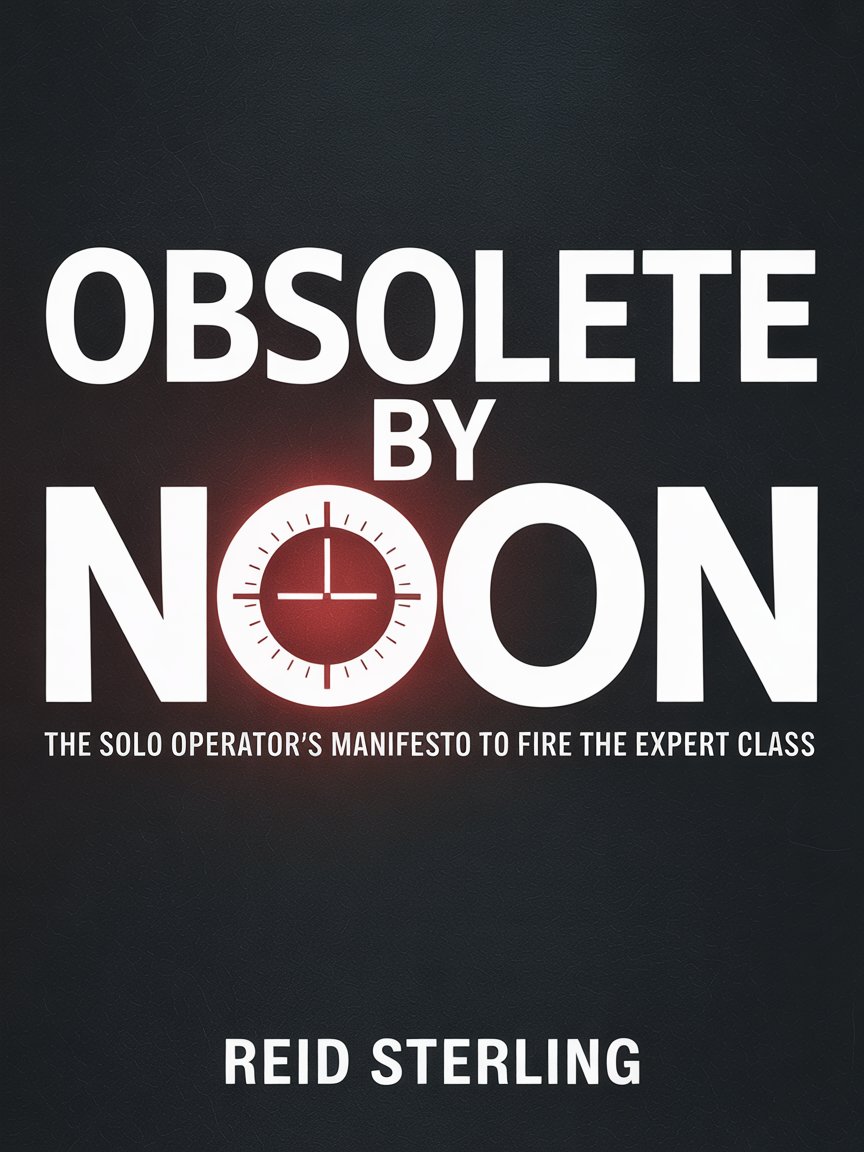
The complete Consultant Killer Stack deployment guide, the Firing Scripts, the Flood Protocol, and the Noon Audit are all inside. The Fog Machine is manufactured. You can turn it off.
Get the Toolkit on Amazon →Frequently Asked Questions
The Consultant Killer Stack, from Reid Sterling's Obsolete By Noon, is a curated configuration of AI tools that replaces the functions of an entire corporate department — legal, strategy, HR, research, financial modeling, and content production — for approximately $186/month. IBM already validated that AI handles 94% of routine HR inquiries. The rest of the stack follows the same principle: AI for execution, you for judgment.
Claude Opus handles standard contract review, identifying risk clauses and producing plain-language explanations. Harvey AI or Spellbook provide legal-specific contract analysis. Perplexity handles legal research with source citations. Monthly cost: $20–$50. This replaces $3,000–$15,000/month in retained legal fees for routine functions — without replacing the attorney's judgment on high-stakes matters.
No. The Stack eliminates the execution layer — the 80% of professional services that is document production, research, analysis, and drafting. It does not replace the 20% that is genuine judgment: high-stakes litigation strategy, novel legal interpretation, negotiation requiring relationship and read-the-room capability. Retain professionals for the judgment layer; use the Stack for everything else.
The 30-day deployment plan: Week 1, run the Noon Audit to identify which professional services functions map to the Stack. Week 2, configure Stack tools and test against real work. Week 3, run parallel operations comparing Stack output to existing services. Week 4, begin the exit process for functions where the Stack meets or exceeds quality. Thirty days to $186/month from thousands per month.
The Fog Machine, from Obsolete By Noon, is the deliberate manufacture of complexity as a profit center — engineered incomprehensibility that keeps clients dependent on expensive professional services. The Consultant Killer Stack is the practical off-switch: it removes the execution layer that the Fog Machine mystifies, exposing the actual judgment content of professional services and making it possible to pay only for that.