The traditional client acquisition model requires resources that solo operators don't have: a marketing team, a content budget, a brand built over decades, a sales team to work the pipeline, an account management function to nurture relationships. This model advantages large organizations — it creates a structural barrier to entry for the solo operator. You cannot compete with the distribution capacity of a company with 12 people in marketing.
Asymmetric Distribution breaks this advantage permanently. Because AI has dropped the cost of content production to near zero, the competitive variable in content distribution is no longer volume of production. It is precision of targeting and quality of signal. A solo operator with 15 years of specific domain expertise, producing highly targeted content about their specific problem-solving capability, outperforms a generic marketing operation — because precision beats volume in a high-noise content environment.
This is the asymmetry: you have the expertise. AI gives you the production capacity. The large organization has production capacity but lacks the specific expertise that makes content valuable to a precise audience.
Component 1: The Positioning Anchor
Before you distribute anything, you need a positioning statement precise enough to act as a filter — attracting exactly the right clients and repelling everyone else. Most professionals resist this specificity. They worry about narrowing their audience. This is the wrong concern. In a high-volume content environment, generic positioning gets lost. Specific positioning creates recognition. The right client reads your positioning statement and thinks: "This person is describing my exact situation."
Your positioning anchor answers four questions: Who specifically are you for? (Not "entrepreneurs" — be specific.) What specific problem do you solve? (Not "grow their business" — what specific, named problem?) What is your specific mechanism? (What do you do that others don't or can't?) What is the specific outcome? (With numbers, timelines, and named benefits.) Build this into every piece of content you produce. It is the thread that makes everything coherent and recognizable.
Component 2: The Primary Channel
Choose one channel. Not "a presence everywhere." One channel where your ideal client type concentrates. For B2B professional services: LinkedIn. For technical audiences: Twitter/X or Substack. For creative and design professionals: Instagram or Behance. For research and intellectual audiences: Substack. For consumer-facing businesses: the platform where your buyer actually spends time.
The rule: you will not build meaningful distribution in 4 places at once as a solo operator. You will build strong distribution in 1 place. AI allows you to repurpose from that primary channel to secondary channels automatically — but your original creative effort goes to one place.
Component 3: The Signal Content System
Signal content is content that demonstrates your specific expertise so precisely that only your ideal client recognizes its full value. This is the key distinction between signal content and visibility content:
Visibility content: "5 Tips for Better Business Performance." Generic. Attracts a broad audience with low intent. Easy to produce. Low client qualification value.
Signal content: "The 3 Operational Failure Modes That Kill Series B Companies Before Series C (And Why They Don't Show Up in Financial Statements Until 6 Months After They Start)." Specific. Attracts precisely the clients who are experiencing or fear that problem. Hard for a generic marketing team to produce because it requires specific expertise. High client qualification value.
Signal content acts as a self-qualification mechanism. The client who reads it and recognizes their situation is already sold on the fact that you understand their problem. The sales conversation becomes a discussion of fit and logistics, not a persuasion exercise.
The AI role in signal content: You supply the expertise — the specific patterns, the specific failure modes, the specific mechanisms. AI handles the production — the structure, the editing, the distribution formats. The content is valuable because of your domain knowledge. AI makes it scalable because it does the execution.
Weekly system: 1 long-form piece per week (article, essay, or substantial LinkedIn post) — your detailed analysis of a specific problem your ideal client faces. 4–6 hours total; you contribute the insight, AI contributes the structure and drafts. 3–5 short-form posts per week — excerpts, specific observations, quick tactical insights. 30 minutes per week total via AI reformatting from your long-form source. 1 direct message or email per week to 3–5 highly specific prospects — personalized outreach referencing something specific about their situation. AI assists with research and draft; you write the final version.
A solo operator running Asymmetric Distribution reaches a smaller audience than a 50-person company's marketing department — but the right audience, with high recognition and intent. The marketing department's content reaches a larger audience with lower recognition and intent. For premium professional services, high recognition beats high volume every time. The conversion rate difference is not marginal — it is structural.
Component 4: The Inbound Conversion Architecture
When content works, inbound inquiries arrive. The conversion architecture moves a prospect from "I found this useful" to "I'm ready to engage."
Step 1 — The Lead Magnet: One highly specific, genuinely valuable free resource that demonstrates your judgment on the exact problem your ideal client has. Not a generic ebook. A document that only someone with your specific experience could produce — a diagnostic framework, a specific cheat sheet, a breakdown of the failure modes you've personally observed. This document acts as the depth demonstration. It shows the client that your content is not just clever writing — you have actual operating knowledge.
Step 2 — The Qualification Conversation: When a prospect inquires, the first conversation is a qualification call, not a sales call. Your objective is to determine whether you can actually help them and whether they're the right client. You are evaluating them as much as they are evaluating you. This framing — you're evaluating them — is not a psychological trick. It is accurate. As a solo operator with limited client capacity, you need to work with clients where you can deliver the specific outcomes you've positioned around.
Step 3 — The Offer: Present a specific engagement with specific deliverables, a specific timeline, and a specific outcome you're committing to. Priced on value, not hours. The specificity is what separates this from "consulting."
The Timeline That's Actually Realistic
Month 1–2: Infrastructure setup. Positioning defined. Channel selected. Lead magnet built. Content system configured. No visible results yet — this is normal. Month 3–4: Content begins to accumulate. Inbound signal starts to emerge. First qualified prospects arrive from content, not outreach. Month 5–6: Compound distribution effects appear. Earlier content continues to drive inbound. Referrals from initial clients begin. The pipeline starts to feel self-sustaining. Month 7+: System producing consistent inbound from a specific, qualified client pool. Your job is to maintain the content system and handle the inbound.
Most professionals abandon at Month 2 because "it's not working yet." The distribution compounding hasn't started. The professionals who persist through Month 4 rarely need to abandon it after. The time variable is not a bug in the system. It is the barrier that keeps competitors out.
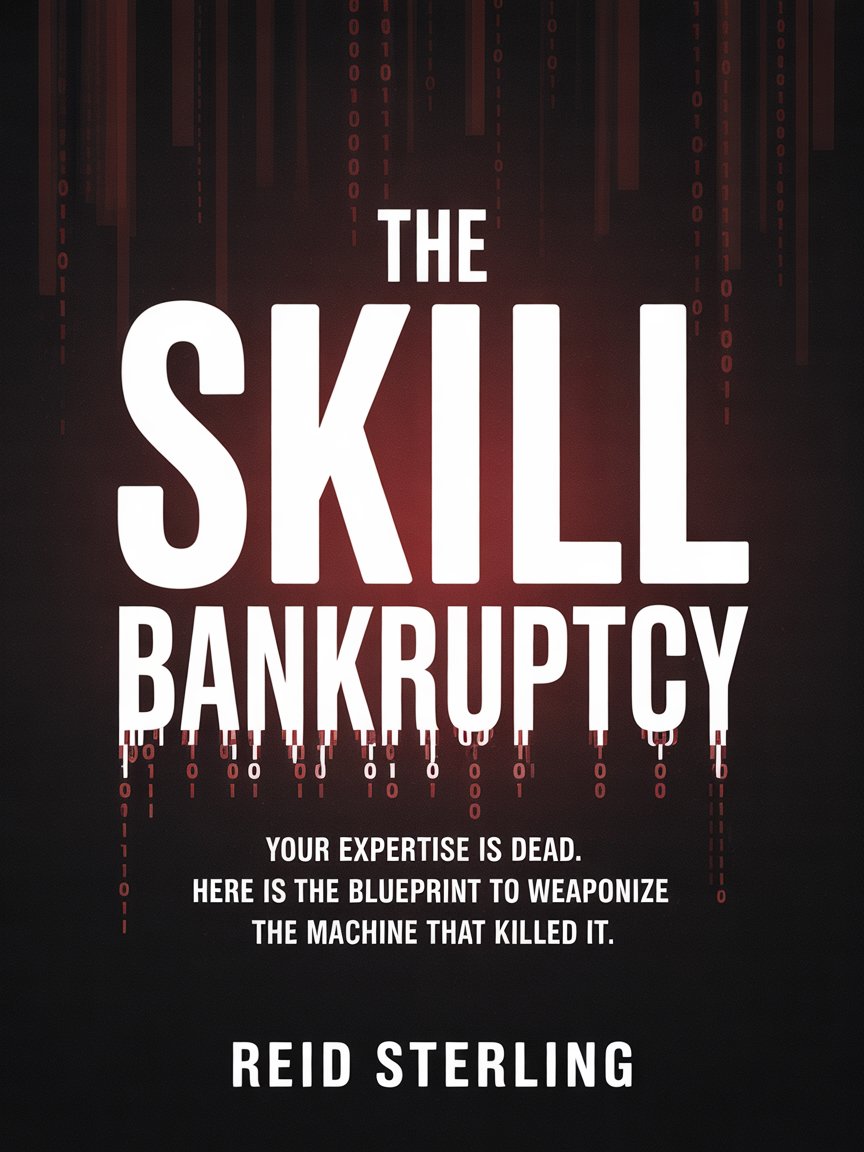
The complete Asymmetric Distribution framework, Anti-Commodity Positioning, AI Leverage Stack, and the full One-Person Unicorn architecture are inside. Stop selling to everyone. Start distributing to exactly the right someone.
Get the Distribution Blueprint on Amazon →Frequently Asked Questions
Asymmetric Distribution, from Reid Sterling's The Skill Bankruptcy, is the client acquisition system for solo operators — designed to reach and convert high-value clients without a sales team, marketing budget, or legacy brand. It leverages the AI-driven collapse in content production costs to let a single operator produce and distribute more targeted, high-signal content than a company with a full marketing department. A solo operator with deep domain expertise and a $200/month AI stack can out-publish, out-target, and out-convert a generic marketing operation of any size.
(1) The Positioning Anchor — a precise statement that acts as a filter, attracting exactly the right clients and repelling everyone else. (2) The Primary Channel — one channel where your ideal client concentrates, built to strong distribution rather than weak presence everywhere. (3) The Signal Content System — content that demonstrates specific expertise so precisely that only your ideal client recognizes its full value; acts as a self-qualification mechanism. (4) The Inbound Conversion Architecture — lead magnet, qualification conversation, and value-priced offer that moves prospects from "useful" to "engaged."
Visibility content is generic — "5 Tips for Better Business Performance." It attracts a broad audience with low intent. Easy to produce, low client qualification value. Signal content is specific — it demonstrates your expertise so precisely that only your ideal client recognizes its full value. The client who reads it and recognizes their situation is already sold on the fact that you understand their problem. The sales conversation becomes fit and logistics, not persuasion. Signal content requires your specific domain knowledge; visibility content requires only AI.
The system works through compounding: early content continues to drive inbound as it ages, accumulates search visibility, and reaches expanding networks through sharing. In months 1–2, nothing is visible because there is no mass yet. By months 5–6, earlier content is still delivering — while new content adds to the pile. The professionals who abandon at month 2 exit before the compounding starts. The time variable is not a flaw — it is the barrier that keeps competitors out once you've built it.
It works for any professional services business where the buyer can be reached through content — which is most B2B professional services. It works best where the buyer has a specific, named problem and is actively seeking information about it (rather than being unaware of the problem category). It is least effective for commoditized services where buyers select primarily on price, and for services where buyers are unreachable through content channels. The prerequisite is a positioning anchor specific enough to make signal content possible.