The therapist says: manage your anxiety. The medication tries to reduce it. The productivity coach says: learn to calm down. The self-help industry has built a $13 billion annual revenue on the premise that anxiety is something to be treated, managed, suppressed, and ideally eliminated.
They're looking at the wrong variable.
Anxiety is not a misfire. It is a threat-detection system operating at full sensitivity in an environment that its evolutionary designer — tens of thousands of years of selection pressure in genuinely dangerous environments — built it for. The problem is not that the anxious brain is broken. The problem is that modern environments present few threats worth the system's full sensitivity. The hardware is correct. The environment mismatched it.
What the anxiety management industry treats as a symptom to reduce is, in the right context and with the right tools, the most powerful risk intelligence system available to any operator. This is the argument of Pity You're Not Anxious — and it is not consolation. It is a competitive framework built on the mechanism.
The Threat Architecture: What Anxious Brains Actually Do
The anxious brain does not simply feel more fear than a calm brain. It runs a fundamentally different threat-modeling process. The amygdala — the brain's primary threat-detection circuit — in an anxious brain activates with lower thresholds, maintains activation longer, and integrates threat signals from more information channels simultaneously than a calm brain's amygdala does.
The practical result: anxious operators consider more failure scenarios, in more detail, over longer time horizons than calm operators. They model second and third-order consequences that optimistic thinkers skip. They catch asymmetric risks that aggregate data analysis misses. They notice the thing that seems fine but is one step from catastrophic, at a stage when calm operators haven't registered it as a threat at all.
This is not negative thinking. It is granular scenario modeling. The anxious operator is running what project managers call a pre-mortem — a structured analysis of how a plan fails — but running it automatically, continuously, on every situation they encounter, without being asked. The calm operator has to be explicitly prompted to do this analysis. The anxious operator does it by default, on everything, all the time.
The question is not whether this capability is valuable. It obviously is. The question is whether it is deployed productively or consumed by the physiological anxiety response — the physical symptoms, the rumination loops, the paralysis. The answer depends entirely on whether the anxious operator has a tool for converting threat-detection output into productive analysis rather than into shutdown.
"Every successful business decision is a bet about the future. The anxious operator has modeled more futures than anyone else in the room. That is not a liability. That is the most valuable pre-work imaginable."
Anticipatory Intelligence: What Calm People Miss
Consider what a due diligence process actually is. You are trying to find the ways a deal, a hire, a partnership, or a market entry can go wrong — before it goes wrong. The anxious operator does this automatically. The calm operator does it when they remember to, when someone else prompts them, when the checklist includes it.
Research on decision quality in high-stakes environments consistently shows that the best-performing operators are neither maximally calm nor maximally anxious — they are moderately anxious in a specific way: anxious enough to model failure scenarios thoroughly, calm enough to act despite the models. The anxious operator who learns to act despite their models performs better than the calm operator who never built thorough models to begin with.
Study of successful venture capital investors — a profession whose entire value proposition is accurately modeling failure scenarios before capital deployment — finds that the most successful investors systematically demonstrate higher anxiety trait scores than average while simultaneously demonstrating a high tolerance for acting despite uncertainty. The pattern is consistent: they see more threats than optimists, and they place bets anyway. The anxiety does not prevent action. It informs it.
This is Anticipatory Intelligence: the specific cognitive advantage produced by hypertuned threat detection. It is not about worrying more. It is about having a richer, more complete model of the risk landscape — and using that model to make better decisions, catch problems earlier, and prepare for contingencies that calm operators encounter as surprises.
The Signal Problem — and the Calibration Solution
The anxious operator's threat-detection system produces high-fidelity signals in high volume. This is where the system becomes a liability: not in the quality of individual signals, but in the volume. Not every signal is actionable. Not every threat scenario is worth defending against. The anxious operator who acts on every signal generated by their threat-detection system will be paralyzed — not because they are wrong about the threats, but because the total volume of action required by all possible threats is larger than any system can handle.
The solution is not to reduce the signal. It is to calibrate the response.
Signal triage: Sort incoming threat signals into three categories — Immediate (requires action this week), Monitor (requires tracking, not action now), and Acknowledge (real but low-probability, log and release). The anxious brain generates all three constantly and struggles to distinguish between them. The triage protocol forces the distinction.
Pre-built response protocols: For each category of threat your business faces, have a pre-built response protocol — a defined action sequence that activates automatically when the threat signal arrives. The anxious operator without protocols has to develop a response under anxiety, which is the worst cognitive state for clear planning. The anxious operator with protocols converts the threat signal directly into the protocol execution — bypassing the paralysis step entirely.
The shutdown audit: The anxious operator in shutdown — paralyzed by the volume of threat signals — is not receiving too much information. They are overwhelmed by the absence of a system for processing it. The shutdown audit asks: which specific threat signal triggered this? Is it Immediate, Monitor, or Acknowledge? What is the protocol? Identifying the specific signal that triggered shutdown almost always converts paralysis into action, because the specific signal is manageable — the generalized feeling of everything being threatening is not.
The Anxiety-to-Edge System
The goal is not to eliminate anxiety. The goal is to extract its intelligence output while preventing the physiological cascade from consuming the operator. The Anxiety-to-Edge System is the operational framework for this conversion.
Three components:
Intelligence extraction: When anxiety activates, before addressing the physiological response, extract the intelligence. Write down specifically what the threat signal is. What scenario is your threat-detection system modeling? What is the failure mode it is pointing to? This externalization converts an internal alarm into a specific, reviewable risk item — and the act of writing it down almost always reduces the physiological intensity, because the system no longer has to maintain the alarm signal at high volume to prevent you from ignoring it.
Triage and protocol activation: Once the intelligence is extracted and external, triage it. Immediate, Monitor, or Acknowledge? If Immediate — activate the pre-built protocol. If Monitor — enter it in the monitoring system and set a review date. If Acknowledge — write it in the log, note why it's low-probability, and release it. The anxious system is satisfied once it knows the threat has been registered. It does not need you to solve it immediately. It needs to know it hasn't been missed.
Deployment in strategic contexts: Use the anxious threat-detection system deliberately in high-stakes analysis. Before launching a product, executing a hire, signing a contract, or entering a market — run the threat-detection system explicitly. Ask your anxiety what it sees. This is a formal pre-mortem, run by the highest-sensitivity risk intelligence system available: your own anxious brain. The calm operator in the room does not have access to this tool. You do.
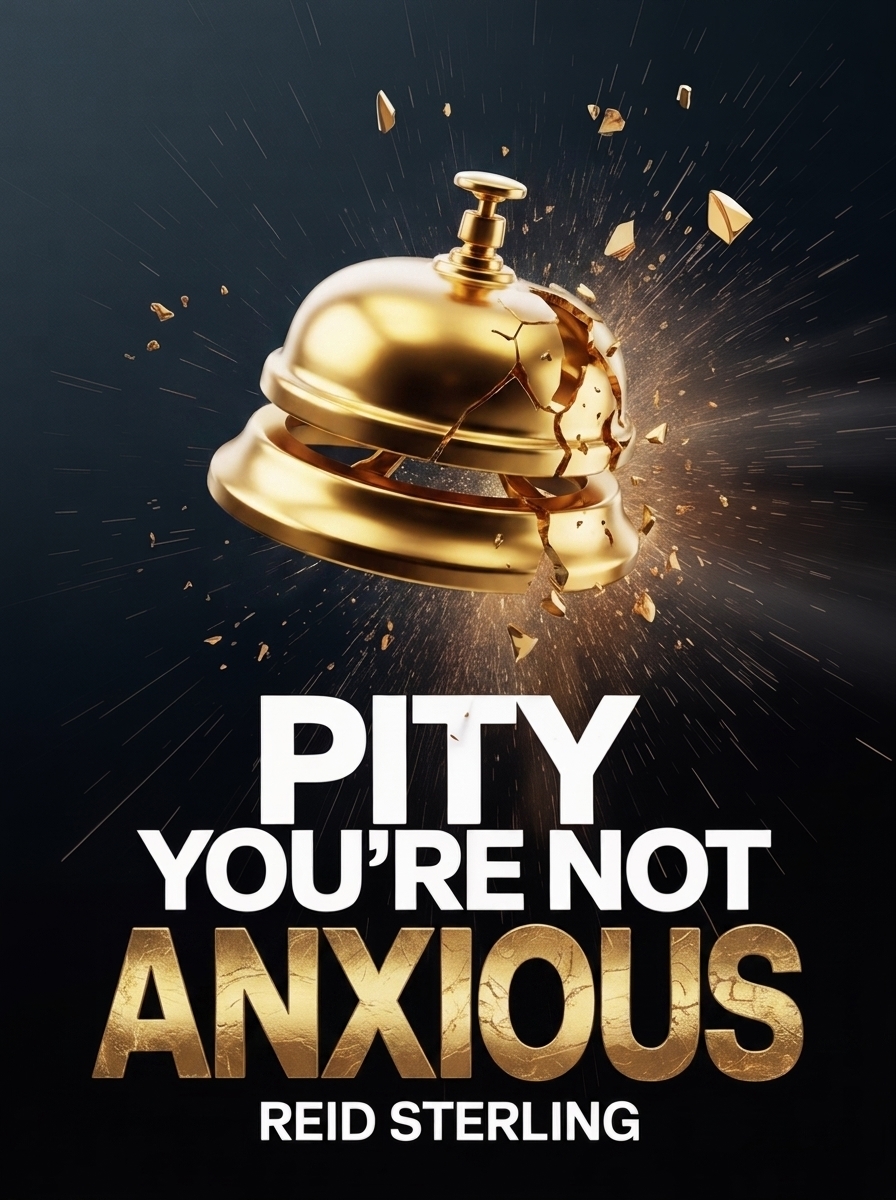
The argument is not that anxiety is better than calm, or that clinical anxiety disorders don't cause genuine suffering. The argument is that the threat-detection mechanism at the core of anxiety produces real, documented cognitive advantages in specific contexts — and that most anxious operators are receiving the liability of the mechanism (physiological distress, rumination, paralysis) without deploying the asset (superior risk intelligence, scenario modeling, anticipatory analysis). Signal Calibration and the Anxiety-to-Edge System are tools for extracting the asset. They are not treatments for the disorder.
Anticipatory Intelligence, from Reid Sterling's Pity You're Not Anxious, is the specific cognitive advantage produced by hypertuned anxiety: the ability to model failure scenarios at depth and breadth that calm, optimistic operators never reach. The anxious brain runs a continuous pre-mortem on every situation — not because it chooses to, but because the threat-detection architecture does it automatically. Deployed deliberately, this produces risk intelligence that calm operators have to be explicitly prompted to generate.
Paralysis in the anxious operator is not caused by too much intelligence — it's caused by the absence of a system for processing the intelligence. The Signal Calibration Protocol provides that system: triage signals into Immediate, Monitor, or Acknowledge; activate pre-built response protocols for each category. The anxious system is satisfied when it knows a threat has been registered and routed. Paralysis resolves when the signal has a destination — it does not require the threat to be eliminated.
The Signal Calibration Protocol, from Pity You're Not Anxious, is the process for sorting anxiety's high-volume threat signals into actionable categories: Immediate (action this week), Monitor (track without acting now), Acknowledge (real but low-probability — log and release). The anxious brain generates all three continuously and cannot distinguish between them without a triage system. The Protocol provides the system, converting the signal from overwhelming noise into prioritized intelligence.